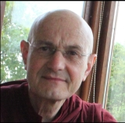
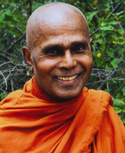
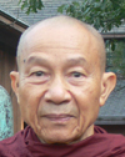
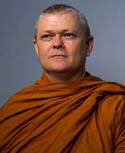
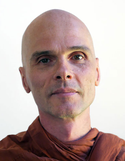
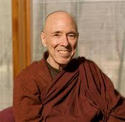
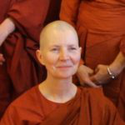
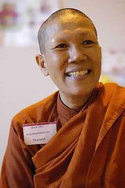
Bhante Bodhidhamma, as lay person practiced at Throssel Hole Zen Priory in north England, later with Sayadaw U Janaka in Burma and at various places with Sayadaw U Pandita. He ordained in 1986 and spent 8 years in Sri Lanka, returning to UK in 1998. He was the resident teacher at Gaia House, UK, 2001-2004. In 2007, he founded Satipanya Buddhist Retreat on the borders of Wales., devoted to vipassana in the tradition of the Mahasi Sayadaw.
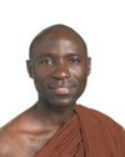
Bhante Buddharakkhita was born and raised in Uganda. Meditating since 1993, he was ordained as a Theravada Buddhist monk in 2002. Now residing at Bhavana Society in WV, he teaches worldwide and in 2005 founded the Uganda Buddhist Centre.
Bhante Henepola Gunaratana is the founding abbot of the Bhavana Society. Born in rural Sri Lanka, he has been a monk since age 12 and took full ordination at age 20 in 1947. He came to the United States in 1968. “Bhante G” (as he is fondly called by his students) has written a number of books, including the now-classic meditation manual Mindfulness In Plain English and its companion Eight Mindful Steps to Happiness. Bhante G regularly leads retreats on vipassana, mindfulness, metta (Loving-friendliness), concentration, and other topics both at the Bhavana Society and elsewhere.
Bhante Gunaratana is an internationally recognized author and meditation teacher. Prior to coming to the United States, he spent five years doing in missionary work with the Harijanas (Untouchables) of India and ten years in Malaysia. He has taught in a number of settings, including American University of Washington DC where he served as Buddhist chaplain and the Buddhist Vihara of Washington DC, where he served as president. Bhante G has a strong scholarly background and livelong commitment to dhamma.
In 1985 Bhante G co-founded the Bhavana Society and became its abbot. He continues to teach in the direct, compassionate style that characterizes his books and articles. Bhante G conveys a well-rounded approach to Buddhist Dhamma, touching on all aspects of the Noble Eightfold Path. He emphasizes metta bhavana (the cultivation of loving-friendliness) as a basis for samma-samadhi, or right concentration. As a teacher, he is known for his emphasis both on samadhi and on metta as part of spiritual training.
In 1996, Bhante G received the title of Chief Sangha Nayaka Thera for North America. This acknowledged his status as highest-ranking monk of his sect in the United States and Canada. In 2003, his autobiography, Journey to Mindfulness, was published. In 2005, the Sri Henepola Gunaratana Scholarship Trust was founded under his guidance. This trust provides educations for poverty stricken children in rural Sri Lanka.
Bhante Khippapanno, ordained a Buddhist monk in 1949, practiced vipassana in India and Burma with Dipa Ma, Mahasi Sayadaw and Shwe Oo Min Sayadaw. He founded Jetavana Vihara, Washington, DC, 1982, and Sakyamuni Meditation Center, CA, 1988. He helped establish Phuoc Son Meditation Center, Vietnam, 1994.
Bhante Sujato left a career as a musician to become a Buddhist monk in 1994. He took higher ordination in Thailand and lived there in forest monasteries and remote hermitages. He spent several years at Bodhinyana Monastery in Western Australia before founding Santi Forest Monastery in New South Wales in 2003. Following Bhante Sujato’s wishes, Santi became a nun’s monastery in 2012, and he returned to live in Bodhinyana. In 2019, Bhante Sujato moved to Sydney to establish Lokanta Vihara (the Monastery at the End of the World) with his long term student, Bhante Akaliko, to explore what it means to follow the Buddha’s teachings in an era of climate change, globalised consumerism, and political turmoil.
Ven. Bhikkhu Analayo was born in Germany in 1962 and ordained in Sri Lanka in 1995. In the year 2000 he completed a PhD thesis on the Satipatthana-sutta at the University of Peradeniya which was published as the highly regarded book Satipatthana: The Direct Path to Realization. At present, he is a professor at the Numata Center for Buddhist Studies, University of Hamburg, and works as a researcher at Dharma Drum Buddhist College, Taiwan.
Bhikkhu Bodhi is an American Buddhist monk originally from New York City. He lived as a monk in Sri Lanka for 24 years and now lives at Chuang Yen Monastery in upstate New York. Ven. Bodhi has many important publications to his credit, either as author, translator or editor, including The Middle Length Discourses of the Buddha (Majjhima Nikaya, 1995) and The Connected Discourses of the Buddha (Samyutta Nikaya, 2000). A full translation of the Anguttara Nikaya is due out in 2011. In 2008 he founded Buddhist Global Relief, a Buddhist organization dedicated to providing relief from poverty and hunger among impoverished communities worldwide.
I aspire to offer teachings that are encouraging, that support people to discover how they are an expression of Dhamma. I'm particularly interested in the interplay between stilling and settling the mind, and opening to greater kindness and generosity of heart.
Venerable Dhammananda Bhikkhuni is Thailand’s first fully ordained Theravada Buddhist female monk and abbess. She is the spiritual leader of Songdhammakalyani Temple located about an hour southwest of Bangkok. Ven. Dhammananda offers a unique perspective as both an ordained Theravada Bhikkhuni and a feminist, and has been internationally recognized for her work on women in Buddhism and environmental conservation. Prior to her ordination, she was an Associate Professor of Buddhist Studies at Thammasat University for 27 years. She is a tireless crusader for women’s ordination and has traveled the world speaking to audiences about the need to restore the “fourth pillar” of Buddhism.