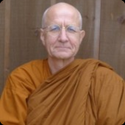
Ajahn (formerly Vitauts Akers), was born in Germany, 1947, to Latvian refugee parents. They moved to Toronto when he was four years old. Around 1969, while living in India, he encountered Buddhism, meeting the late Sāmanera Bodhesako, who introduced him to the teachings of the Buddha. He eventually travelled to Thailand to become a novice at Wat Mahathat in 1973 and took bhikkhu ordination the following year at Wat Pah Pong with Ajahn Chah. He was one of the first residents at Wat Pah Nanachat, the international monastery in north-east Thailand. Having spent four years in Thailand, he went back to Canada to visit his family in 1977. Instead of returning to Thailand, he was asked by Ajahn Chah to join Ajahn Sumedho at the Hampstead Vihāra in London. Later, he was involved in the establishment of both the Chithurst and Harnham monasteries in the UK. In 1985, invited by the Wellington Theravāda Buddhist Association, he moved to New Zealand, accompanied by Venerable Thanavaro, where he lived for 10 years, setting up Bodhinyānārāma monastery. In 1995 he came to the UK to assist Ajahn Sumedho at Amarāvati and stayed for four years before returning to New Zealand, where he lived until 2002. He was living in Ottawa caring for his mother for nine years and is now resident full time at Tisarana.
The theme of this Sunday talk: Right effort, cultivating the skillful, and abandoning the unskillful.
Luang Por reflects on right effort, and effort as a skill, rather than wholesome and un-wholesome, as it is sometimes referred to.
Everything that arises, is natural, even a "murderous impulse". But whether we follow and cultivate it, is what is important. When the skillful is cultivated, we experience benefit for ourselves, and others, when the unskillful is followed and cultivated, it leads to harm, for ourselves and others. The practice of right effort then, lies, in first recognising fully, and discerning what is arising, and secondly, knowing how to follow the skillful, and abandon the unskillful.
The theme of this Sunday talk, the Four Noble truths. Buddhist traditions may vary in many ways, but the one common teaching in each one is this one.
Is there a wellbeing that is not relative to situations? That remains unchanged. This was the Buddha's realisation. And the core of the teaching above.
It allows one to take responsibility for ones discontent.To really understand how things work.
The theme of this Sunday talk, is witnessing experience as it is. The awakened mind, does not demand anything be different to what it is, in the moment free of judgement. The theme that this builds upon, is "Santitikko"- Something that can be verified for oneself. If we can see suffering for what it is, as its is now, in the moment, we get out of it a little easier. So the practice becomes one of Witnessing the way it is now, first. Action can follow later if necessary.
Ajahn Viradhammo reflects on the use of the "Who is thinking" Koan/question. Used during meditation. When one's whole psychological makeup is all about thinking/problem solving only, then doubt will come up. As thinking begets doubt. The depth of spiritual life is about "silence". And one cannot arrive there through thinking. Then one tries to get rid of thinking, and we fall into the trap, of aversion. One has to be able to see thought as an object, in awareness.
Talk given on the lunar observance day. Ajahn Viradhammo reflects on Samana Sanna. Or the values of spiritual life. Contentment with little is one such Samana Sanna that one recollects.
The Sanna (or recollection), acts as a mirror, to the where the mind is. Then when a state of discontent arises, one can see it subjectively, rather than going into "becoming". "It's good enough" being a phrase to use as a guide.
Staying with the theme of "Humility", and I making/My making, "Ahankara/Mimankara", Ajahn Viradhammo urges us to train to notice when this I making and my making is occurring, and to use the "mood of the mind", as a guide to knowing this.
When we notice that the mood of the mind, is an object, not the subject, the foreground, not the background awareness, we can then rest in the background, and see things "as they are". Resting in awareness, letting the moods pass, and not making a self of the mood.
Ajahn Viradhammo, states the importance of finding time to get away from problem solving, and daily tasks. Places of silence like monasteries, afford one the possibility for this. When we get away from recursive thought, and the need to problem solve, we can finally, settle into a silence, that allows one to become aware of awareness. To make that awareness a refuge, rather than all the noise in the "foreground".
Ajahn Viradhammo, contemplates, the means we have to attain fulfilment.
He reflects, on Generosity, as means, living an ethical life, via the precepts, and finally on "Humility". Humility here as a that which is free from the sense of me and mine, or Ahankara Mimankara. Acknowledging the uncomfortable/unpleasant, but residing in the sense of the background, the awareness, that is always here, always present and unchanging.
This talk was given on a visit to Cittaviveka Buddhist monastery (UK) in Jul 2026.
Ajahn Viradhammo, reflects on sense restraint. Without sense restraint attention falls on the conditioned, rather than the unconditioned. We see the foreground, as opposed to the "background" of awareness. While it is possible to "notice" phenomenon, without sense restraint, the mind doesn't truly settle into silence without sense restraint, and the falling away of the noise caused by input from the senses. It is in the silence of the mind, that attention on awareness can flourish.