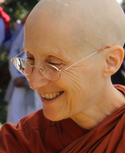
Ayyā Medhānandī Bhikkhunī, is the founder and guiding teacher of Sati Sārāņīya Hermitage, a Canadian forest monastery for women in the Theravāda tradition. The daughter of Eastern European refugees who emigrated to Montreal after World War II, she began a spiritual quest in childhood that led her to India, Burma, England, New Zealand, Malaysia, Taiwan, and finally, back to Canada.
In 1988, at the Yangon Mahasi retreat centre in Burma, Ayyā requested ordination as a bhikkhunī from her teacher, the Venerable Sayādaw U Pandita Mahāthera. This was not yet possible for Theravāda Buddhist women. Instead, Sayādaw granted her ordination as a 10 precept nun on condition that she take her vows for life. Thus began her monastic training in the Burmese tradition. When the borders were closed to foreigners by a military coup, in 1990 Sayādaw blessed her to join the Ajahn Chah Thai Forest Saņgha at Amaravati, UK.
After ten years in their siladhāra community, Ayyā felt called to more seclusion and solitude in New Zealand and SE Asia. In 2007, having waited nearly 20 years, she received bhikkhunī ordination at Ling Quan Chan Monastery in Keelung, Taiwan and returned to her native Canada in 2008, on invitation from the Ottawa Buddhist Society and Toronto Theravāda Buddhist Community, to establish Sati Sārāņīya Hermitage.
Ayya Medhanandi reflects on the meaning of the different mudras or hand gestures used by the Buddha himself when he gave teachings. Each represents an important quality for us to practise and develop such as fearlessness or compassion. You can see these mudras that she describes on the batik cloth that was gifted to the Ottawa Buddhist Society at https://ottawabuddhistsociety.com/about-the-obs/latvian-buddha-batik/
Fire is our teacher - the fire of pain, the fire of persevering through difficulty and the fire of going beyond what we think we are capable of. For we are greater that we know and our journey is one of learning to trust what is right and true. When the heart’s compassion, wisdom, and generosity mature, there is no space for fear. All the dross of the world melts away in the silence of pure presence. Here is the absolute sanctity of awareness, unencumbered, and joyous in the knowledge of pure love itself.
Ottawa Buddhist Society (Sisters of St. Joseph Convent)
We can know freedom from suffering when the light of dhamma (or truth) arises. This illumination will melt the impurities formed by unwholesome mind states. Oh, what a freedom! A talk given during a 10 day Ottawa Buddhist Society retreat at the Sisters of St. Joseph Convent, Pembroke, Ontario, Canada in 2009.
Within us is the seed of awakening. And yet we are so blind. Can we free ourselves by seeing through clouds of delusion, greed and hatefulness? Do we have the resolve and patience to begin and the humility and forgiveness to keep going in hard times? Vigilance in ethical practice, unremitting mindfulness, inner stillness, and sharp discernment melt ignorance and purify the mind. Not only that – joyous and aware, we radiate a fearless unequivocal compassion. When the sun rises, darkness disappears. Just so, we emerge from our blindness, at peace with all conditions
When life presents fearsome obstacles, be your own spiritual ally and turn those obstacles into windows that open to the depths of the heart. There, cultivating loving-kindness, compassion, radiant joy and the wisdom of discernment, behold the fierce gifts of the Dhamma that defy delusion and rescue us from the mire of every perceived burden.
How can we sharpen awareness of thoughts that gush forth in the mind like Niagara Falls? Observe them gently, not clinging and with diligent focus. Our present moment awareness and unstoppable attention, when sustained inwardly, have the transformative power of a Niagara to cleanse the heart of all impurities. Therein is the path to freedom.
Developing awakened wisdom is an organic process, the unbinding of all problems that leads to indestructible peace and harmlessness. We undertake and persevere through training the mind so that we can renounce our attachments and stop the interior whirling of the world. No longer caught in its duality, we rest in knowing the liberating truth of this moment, cessation of suffering and a transcendent healing that takes us to the Deathless.
We hear in the Udana, Verses of Uplift, about the Venerable Meghiya’s wish to practise in the beautiful Mango Grove before his mind was mature enough. Even when we are on retreat and conditions for practice seem perfect, hindrances plague the mind and overcome it with impurities. So we hold fast to the Buddha’s instructions to know for ourselves the radiance of mind that is untainted by ego.
We may travel to the most beautiful setting, and yet if there is no silence on the inside, how can we find peace? But to empty and purify the mind, we enter a sacred space, and we taste only sacredness. We experience a dimension of being that is vast - without boundaries. Like pilgrims, we sit in awe at the wondrous quality of the silent heart. A talk given during a 10 day retreat at the Sisters of St Joseph Convent, Pembroke, Ontario.
With the advent of the Winter Solstice - the shortest day of the year - comes the promise that the light will return. We can honour this principle in our practice by turning towards the light that is revealed in our own minds. The goodness and purity of this light can connect us to unconditional peace and love. A talk given at the Ottawa Buddhist Society in 2008.
An autobiographical portrait of Ayya Medhanandi’s life, from her meeting with her first teacher in India in her early twenties to her career as a nutritionist and going forth to become a Theravada Buddhist nun. She notes the striking similarities between the tenets of her ancient Judaic faith and the principles of Theravada Buddhism. The inward journey goes beyond religious belief - crossing fixed boundaries for the sake of realizing our true spiritual heritage. A talk given at H.R. MacMillan Space Centre, Vancouver, Canada in 2008.
As we follow the steps of the Eightfold Noble Path, our hatred, greed, and delusion abate. We may yet suffer, but we use our suffering to fathom the meaning of it, see its causes, and see the possibility for ending suffering. The four Noble Truths come alive within. Invariably, our suffering manifests in many forms. It may never ‘end’ but it ceases to be a problem as our fear or aversion to it die. Persevering in this work is the way to make peace with our suffering.
What is renunciation? Patiently we learn how to let go of the thoughts and actions that enslave us to samsara. And we begin to understand what it takes to tame the ego and cultivate greater and greater compassion in its boundless quality. Through this magnificent process, we study the way to ascend the altar and sit with our teacher, the Buddha.
Are we able to sit with a quiet mind and know the fragrance of silence? All of us are familiar with the stressful impacts of relentless thought and reactivity on our well-being. The good news is that we can free ourselves from the inner floods and tempests by deepening our meditation practice and intuitive insight. As we hone these skills in conducive conditions, we prepare to test our spiritual mettle in the vicissitudes of everyday life.
Is your mind full of the present moment at all times? We can learn to integrate our practice with our everyday lives as awareness develops when we are both on and off the meditation cushion. With diligence, we can realize a mind that is bright and radiant, full of joy and peace. A talk given at a True North Insight weekend retreat in the Padua Centre, Montreal, Canada.
The meaning of the words “commitment” and “sacrifice” are spoken of in relationship to taking vows and training as an anagārikā as well as to practice as a householder. Regardless of the form we use, it is possible for each of us to find an island of refuge in ourselves. A talk given during an Ottawa Buddhist Society 10 day retreat at the Sisters of St. Joseph Convent, Pembroke, Ontario, Canada in 2008.
How can we beat a path to awakening? Meditate and develop deep, wise insight, training like a spiritual athlete in this new millenium. Like forging a trail in dense forest, walk it again and again, courageously enduring difficulties to navigate beyond mental afflictions. Study the mind incisively and trust - we will arrive.
What is spiritual beauty? Kindness, forgiveness, unconditional love? Can we sustain a hallowed inner space that will not be degraded by unkind thoughts? When noble virtue protects the heart at its innermost core, we repair and train the mind to go beyond all brokenness. Relinquishing the burden of endless struggle, we harness awakened wisdom and compassion to free ourselves. We are a pure clear vessel of unfathomable love.
Our most valued renewable resource is the heart, the seat of awareness and our true refuge in what is worthy of refuge – the ancient virtue of the noble ones. Breath by breath, we embody pure presence, wisely seeing how suffering arises and understanding the Noble Truth of how it ends. With courage enough to face our fear, we cut the currents of negativity and we stop feeding them. This is our path to the ending of pain – the heart’s total release.
We must not underestimate the significance of dedicating ourselves to the five precepts. Such a commitment to virtue provides a moral and ethical basis for life that will ultimately lessen our suffering. We find ourselves embodying qualities of truthfulness, kindness and care for ourselves and others that touch a new level of inner happiness, one of the factors of enlightenment.
How training the mind in following precepts, such as the rules regarding the use of four monastic requisites - food, robes, shelter, and medicines, can win us greater patience, faith, gratitude, calm, courage, and mindfulness. Such ways of renunciation test our commitment to the path and teach us how to forgive and let go even our fears so that we harvest the riches of joy, compassion and inner peace.
Why does anger cause us so much misery? As long as we feed it, anger insidiously undermines our spiritual work. Mindful and aware, we learn to refrain from feeding that angry dog and we loosen its foothold within the mind. By the power of loving-kindness and compassion, we disarm anger's toxicity and restore peace. These are the supreme medicines that will guide us through the wilderness of anger.
National University of Singapore Buddhhist Society
Step by step instructions on developing meditation practice by beginning with close attention to the breath. Gradually investigate the impermanent nature of wanting, aversion, sleepiness, restlessness, and doubt as they arise and overcome these five obstacles to practice. With curiosity and determination, return again and again to the breath. As the mind is stilled and purified, explore the clarity, calm and spaciousness of its vast inner depths.
The Buddha gives us lessons in freeing ourselves but there are critical choices to be made - an emptying out, a readiness, a rising up, a deep yearning for truth. We are compelled to trust so completely to wake up to the peace in our hearts, offering the best we can. It's a harvest of wisdom. And in this remarkable learning, we receive the great gift of a love, a compassion, a kindness that pervades us and, in turn, allows us to extend it to all beings.
By practising awareness of your breath you will begin to understand your mental and physical processes and develop mindfulness. You will know what is happening as it happens, and you will be able to recognize a hindrance and turn it off. Spiritual regret for past unwholesome actions can develop and you will be able to abandon
them and let go of a lifetime’s accumulation of baggage. A talk given at a 10 day Ottawa Buddhist Society retreat at the Galilee Centre, Arnprior, Ontario, Canada.
How can we calm the mind in order to not be overwhelmed by thoughts and emotions? We can learn to live skillfully by realizing how the mind and body really work. Don’t be angry with your anger, don’t be caught up with your desires, don’t be overwhelmed by your delusion. But, go beyond and find an island of peace that can result in the ethical perfection that is known as enlightenment. A talk given during an Ottawa Buddhist Society 10 day retreat in Arnprior, Ontario, Canada.
When you move towards what is fearful step by step with courage, it is possible to overcome the darkest moments breath by breath. Draw together all the threads of your life, and let each one go strand by strand. A guided meditation on death at a 10 day retreat, Galilee Centre, Arnprior, Ontario Canada.
Shrouded in the cloud of ignorance, we believe that suffering will never happen to us. But when we emerge from that fog into a radical simplicity of heart, suffering becomes our teacher. Our eyes are opened thanks to Right View and direct experience of the Four Noble Truths. At last we transcend the tyranny of fear.
Bodhinyanarama Monastery, Stokes Valley, New Zealand
Practice means we keep trying to purify the mind and strengthen our commitment to the precepts. There is no failure – we just begin again and again until we find our Dhamma wings. A short talk given during a Theravada Buddhist Community (TBC) retreat in Toronto.
While living in New Zealand, Ayya Medhanandi pays respects to the relics of St. Therese de Lisieux that were brought to the Catholic Cathedral in Wellington during a world tour. In this interview for the Catholic diocese, she reflects on what drew her to the spirituality of St. Therese.
Bodhinyanarama Monastery, Stokes Valley, New Zealand
Can we fearlessly accept all that life gives with a wise and compassionate heart? We see how the sun shines unilaterally on all beings giving life and nourishment. But we must use sharp wisdom to discern what is harmful and abandon that; and to know what is wholesome and cultivate that. Even as a mother, may we emulate the Buddha's compassion that flows without bias in all directions across millenia.
Bodhinyanarama Monastery, Stokes Valley, New Zealand