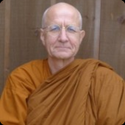
Ajahn (formerly Vitauts Akers), was born in Germany, 1947, to Latvian refugee parents. They moved to Toronto when he was four years old. Around 1969, while living in India, he encountered Buddhism, meeting the late Sāmanera Bodhesako, who introduced him to the teachings of the Buddha. He eventually travelled to Thailand to become a novice at Wat Mahathat in 1973 and took bhikkhu ordination the following year at Wat Pah Pong with Ajahn Chah. He was one of the first residents at Wat Pah Nanachat, the international monastery in north-east Thailand. Having spent four years in Thailand, he went back to Canada to visit his family in 1977. Instead of returning to Thailand, he was asked by Ajahn Chah to join Ajahn Sumedho at the Hampstead Vihāra in London. Later, he was involved in the establishment of both the Chithurst and Harnham monasteries in the UK. In 1985, invited by the Wellington Theravāda Buddhist Association, he moved to New Zealand, accompanied by Venerable Thanavaro, where he lived for 10 years, setting up Bodhinyānārāma monastery. In 1995 he came to the UK to assist Ajahn Sumedho at Amarāvati and stayed for four years before returning to New Zealand, where he lived until 2002. He was living in Ottawa caring for his mother for nine years and is now resident full time at Tisarana.
Ajahn Yatiko was born and raised in Edmonton, Alberta, in 1968. He had a strong interest in religion from childhood and after a few years at university decided he needed to find a spiritual teacher, as opposed to an academic one. He was on his way to Tibet for ordination, but the plane stopped off in Bangkok on route. While having lunch in a Bangkok restaurant, a few Thai laymen sat down to join him and recommended he go to Wat Pah Nanachat, in Ubon. Owing to their high praise of Ajahn Chah, he decided to investigate. Shortly thereafter Ajahn Sumedho was visiting and Ajahn Yatiko was inspired to pursue monastic training at Wat Nanachat. He has been part of that community since 1992. He arrived at Abhayagiri in January, 2008.
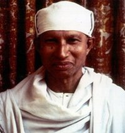
Anagarika Munindra (1915–2003) was a Bengali Buddhist master and scholar who became one of the most important Vipassana meditation teachers of the twentieth century. Unassuming, genuine, and always encouraging, Munindra embodied the Buddhist teachings, exemplifying mindfulness in everything he did.
Ayya Anandabodhi first encountered the Buddha’s teachings in her early teens, igniting a deep interest in the Buddha’s Path of Awakening. She lived and trained as a monastic in the Forest Tradition at Amaravati and Chithurst monasteries in England from 1992 until 2009, when she moved to the US to help open more opportunities for women to live the monastic life. She took full Bhikkhuni Ordination in 2011. Her practice and teaching are guided by early Buddhist scriptures, living in community, and through nature’s pure and immediate Dhamma. Ayya is founder of Parayana Vihara, a monastic community in Port Townsend, WA.
Ayya Anopamahas practiced meditation over two decades and spent extensive time in retreat in Burma where she ordained with the Venerable Pa Auk Sayadaw as a Buddhist nun. She had the good fortune to study with various renowned meditation masters of different traditions over the years and to share the Dharma across continents. Her teaching focuses on wakefulness and compassion and integrates the relational practice of Insight Dialogue. She is affiliated with Tilorien Monastery in Belgium and serves the Global Insight Dialogue Community.
Ayyā Anuruddhā has trained at Sati Sārāņīya Hermitage with Ayyā Medhānandī since 2014. Originally from UK, she came to the Dhamma after serving as a veterinarian and a high school biology teacher. Seeing the entrapments of existence she felt an urgency for spiritual practice. She received bhikkhuni ordination from Ayya Tathaloka in 2017 and is one of Sati Saraniya's core resident Sangha focusing on the profound intersections between scientific knowledge and the Buddhas' wisdom teachings.
Ayya Jitindriyā first trained as a monastic in the lineage of Ajahn Chah & Ajahn Sumedho for over 16 years, from 1988-2004. After leaving the monastic order she gained a Master’s degree in Buddhist Psychotherapy Practice with the Karuna Institute in the UK. Returning to live in Australia (her place of birth) in 2008, she practiced as a Buddhist psychotherapist and taught meditation, Buddhism and psychotherapy in various capacities. She was the Director of Training for AABCAP (Australian Association of Buddhist Counsellors and Psychotherapists) for several years. In early 2018 Jitindriyā re-entered the monastic life at Santi Forest Monastery in NSW and held the role of guiding teacher and Spiritual Director there for a time. In 2021 she helped to set up Viveka Hermitage in Southern NSW where she now resides.
Born in Sri Lanka to a Buddhist family and migrated to the UK in 1982. Lived in Amaravati since 2006. Took 8 precepts in 2008 and received Pabbajja in 2011. Hearing the Buddha’s teachings in primary school, the Eightfold Path resonated as an important set of principles in living as a human being. Establishing the right view and incorporating the Eightfold Path into daily life is the key to practicing.
Ayyā Medhānandī Bhikkhunī, is the founder and guiding teacher of Sati Sārāņīya Hermitage, a Canadian forest monastery for women in the Theravāda tradition. The daughter of Eastern European refugees who emigrated to Montreal after World War II, she began a spiritual quest in childhood that led her to India, Burma, England, New Zealand, Malaysia, Taiwan, and finally, back to Canada.
In 1988, at the Yangon Mahasi retreat centre in Burma, Ayyā requested ordination as a bhikkhunī from her teacher, the Venerable Sayādaw U Pandita Mahāthera. This was not yet possible for Theravāda Buddhist women. Instead, Sayādaw granted her ordination as a 10 precept nun on condition that she take her vows for life. Thus began her monastic training in the Burmese tradition. When the borders were closed to foreigners by a military coup, in 1990 Sayādaw blessed her to join the Ajahn Chah Thai Forest Saņgha at Amaravati, UK.
After ten years in their siladhāra community, Ayyā felt called to more seclusion and solitude in New Zealand and SE Asia. In 2007, having waited nearly 20 years, she received bhikkhunī ordination at Ling Quan Chan Monastery in Keelung, Taiwan and returned to her native Canada in 2008, on invitation from the Ottawa Buddhist Society and Toronto Theravāda Buddhist Community, to establish Sati Sārāņīya Hermitage.