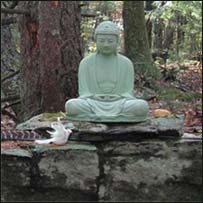
We explore the role of the body in our meditation practice, using the Buddha’s practice of kāyagatā sati (mindfulness immersed in body) as our guide. We forget we are bodies, fooled by our mind’s ability to create realities that are separate from the bodies we are. We explore the practice of mindfulness immersed in body using the Buddha’s instructions to Mahā Kassapa as our guide: “You should train yourself in this way: “I will not abandon mindfulness immersed in body associated with joy.”
We survey the first three of the four satipaṭṭhānas, here translated as “foundations of mindfulness” or “domains of mindfulness” – the places where we station our mindfulness. These are body (kāya), feeling (vedanā) and heart/mind (citta). We see these domains represent a linear progression from less to greater ethical sensitivity; and we also see how feeling holds the practice together.
We look at the first three sentences of the chorus of Satipaṭṭhāna Sutta, where the Buddha explains the arising of insight (vipassanā). We examine “tracking body as body internally and externally,” where the assumed boundary between self and other begins to dissolve. Then we look at how the practitioner opens into the perception of impermanence – “tracking the nature of arising and ceasing as body.” Finally, we examine the entry into emptiness, where the practitioner is mindful that “body is,” for understanding (ñāṇa) and continuous mindfulness (paṭisati).
The scales of judgment confine us in a limited sense of self, they restrict the depth and fullness of our loving. This talk explores the genesis of projecting badness on to parts of ourselves and others, and how we can use mindfulness and self-compassion practices to evolve our consciousness and free our hearts.
Tonight we return to the fundamental meaning of sati as indicating memory, and look at the relationship of memory to wisdom. Our connection with the past allows us to learn from the patterns of experience as they flow over time. Mindfulness allows access to an experienced present that includes everything we have learned through the course of our lives.
We look at the section in Satipaṭṭhāna Sutta where the Buddha speaks of mindfulness of breathing (ānāpāna-sati). We look at the development of the practice from natural awareness to mindfulness to understanding to training to sensing to calming, and we see how the nature of breathing itself transforms as our relationship to it develops.
This morning we experiment in using breathing as a meditation object. How do we know we are breathing? We find movement in the body, air element (vayo dhātu). We practise precision in our mindfulness of breathing by tracking its location, its length, its shape or form, its clarity, its beginnings and ends. This opens up issues regarding both the nature of breathing and our relationship to breathing.
We introduce satipaṭṭhāna, the way of mindfulness. More than just a meditation technique, satipaṭṭhāna represents a way of practice that is a “one-way street” (ekāyana magga) leading direct to nibbāna. We examine the meaning of nibbāna, looking at it both cognitively and affectively. And we discuss the relationship between the practice of tracking experience over time, and nibbāna itself.
We introduce the concept of “mindfulness,” which is the standard translation of the Pāli word sati. Sati literally means “memory,” and mindfulness refers to the act of remembering the present. We find the same meaning in railway station signs that exhort us to “Mind the gap,” to remember to be aware, now. The practice of mindfulness is associated with the felt continuity of awareness, and this is what we are aiming for in our practice.